Tuesday, July 28, 2015

Friedrich Wilhelm Murnau as an Observer in the Great War

Friedrich Wilhelm Murnau, born Friedrich Wilhelm Plumpe (1888-1931), was the director of one of the first vampire films, namely the 1922 feature Nosferatu as well several other films shot both in Germany and the United States. In July 2015, persons unknown broke into his grave and removed the skull of his body, possibly for occult purposes, since candle wax was found around the grave. This was apparently not the first time that someone had tried to break into his final resting place.

Murnau had a great interest in acting from a young age, and he entered Max Reinhardt's acting school after studying art history, literature and philology. However, the First World War led to Murnau volunteering for service, and he was promoted to a  a reserve officer in the Prussian 1st Guards Infantry Regiment in 1915, serving on both the Western Front and in Latvia before transferring the Kaiserliche Luftstreitkräfte.

Somehow, Leutnant der Reserve Murnau managed to squeeze his 210 cm tall body into a First World War-era aircraft, and in April 1917 he started training with Flieger-Ersatz-Abteilung 10 in Böblingen. He then went on to a Offizier-Fliegerschule-Lehrkurs in Warsaw, and finally to a Beobachterschule in Jüterbog. In September 1917 Murnau was posted to Fliegerabteilung (Artillerie) 281 at Chateau Hasard near Lorquin (aptly called Schloss Zufall by the Germans) from where he flew reconnaissance missions over the Verdun area as an observer in Rumpler C.IV and Aviatik C.I two-seaters. He does not seem to have had great luck with his pilots, since it is claimed that he survived in all eight crashes, albeit without serious injuries.

Murnau in front of an Aviatik C.I.

Murnau's colleague, Leutnant Schramm recalled how Murnau would entertain his fellow fliers: "It was 1917 and our regiment of flyers was quartered near Verdun, in a beautiful but rather melancholy chateau abandoned by its owners. Murnau ... was always to be seen by his aircraft, personally making sure that it was serviced properly... On every mission, every flight he did everything as carefully and conscientiously as he arranged his room. ... In the evening, when we sat around in the mess, Murnau had another duty to perform. It was always the same. As the fire threw its dancing, changing shadows on the shifting group of young officers, Murnau had to recite Der Todspieler (The Pianist of Death). I don't know whether he used to do it to please himself, but he did it conscientiously, with the emphasis and the strange intonation, half pathetic and half comic, that proclaimed him the pupil of his great master [theatre director Max Reinhardt - IGR]. He would recite the poem in a ringing voice, his gaunt face quivering [and] our Captain was completely captivated... Outside it was dark and cold, with every so often the dull rumble of the guns. But we sat there quietly, and we were all moved as we listened to the tall Murnau reciting."

On December 4, 1917, Murnau was the observer in what seems to have been a Hannover CL with number C9288 piloted by a Leutnant Meyer. The pilot was to ferry the aircraft from Strasbourg to the unit's airfield in Lorraine. However, the pilot lost his bearings in the heavy clouds, and a storm carried the aircraft in the direction of neutral Switzerland. Swiss onlookers noticed a German aircraft circling over Basel for a good 20 minutes just after four o'clock before landing on a football field near Allschweiler Bachgraben. Murnau and Mayer embarked the aircraft, and they were quickly apprehended by Swiss police and military personnel. Although the Swiss authorities found that the aircraft was armed with a machine gun, it carried no ammunition.

Murnau's aircraft after landing i Basel.

Being interned in Andermatt, the war may have been over for Murnau, but be became friends with Alphons Staehelin-Zahnd (1882-1943), a patron of the arts. Murnau was eventually relocated to a Pension Felsberg in Lucerne, and he was allowed to engage theater communities in Switzerland. He directed the Swiss popular play Marignano that opened in June 1918 - receiving good reviews and a prize - before being repatriated to Germany at the end of the war and once again engaging in film. It is claimed that his wartime experiences on the ground and in the air influenced Nosferatu, and considering the horrifying imagery of the film, that may very well be true.

Sources:
www.tageswoche.ch

www.awesomestories.com

www.theaerodrome.com

www.frontflieger.de

Monday, May 11, 2015

Disco and the Third Reich

Jazz had been popular in France in general and Paris in particular during the decades after the First World War. American and especially black American musicians gained fame and respect as they helped shape the Parisian club scene of the interwar years. In April 1934, Cab Calloway played at the Moulin Rouge. He had just released the song Zah Zuh Zaz in November 1933. The song became vary popular in France, and the onomatopoetic title would lend its name to the Zazou, a French subculture of the post-1940 swing era that was to be targeted by Nazis and French Fascists.

Swing music was, of course, also played by French musicians, and French singer Johnny Hess starred in a Parisian swing cabaret at Le Bagdad at the Rues du Faubourg Saint-Honoré in May 1938. His song Je suis swing became the hit of the production, and the record is released in February 1939, just about half a year before the outbreak of World War Two. Paris was swinging, and Hess would later release Ils sont zazous! to celebrate this particular subculture. Other musicians would be included in the movement, perhaps most notably Django Reinhardt, who played with Alix Combelle at Jimmy's Bar in Montparnasse, an establishment that had Johnny Hess as an artistic director.


There were Zazou in throughout France, but they were, of course, concentrated to Paris. The two most important meeting places were the terrace of the Pam Pam cafe on the Champs Elysees and the Boulevard Saint-Michel near the Sorbonne, but they also met in the cellar clubs of the Dupont-Latin or the Capoulade. The Zazous were typically middle class, and the older and more well-to-do tended to socialize around the Champs Elysees, while the crowd of the Quartier Latin tended to be younger. 


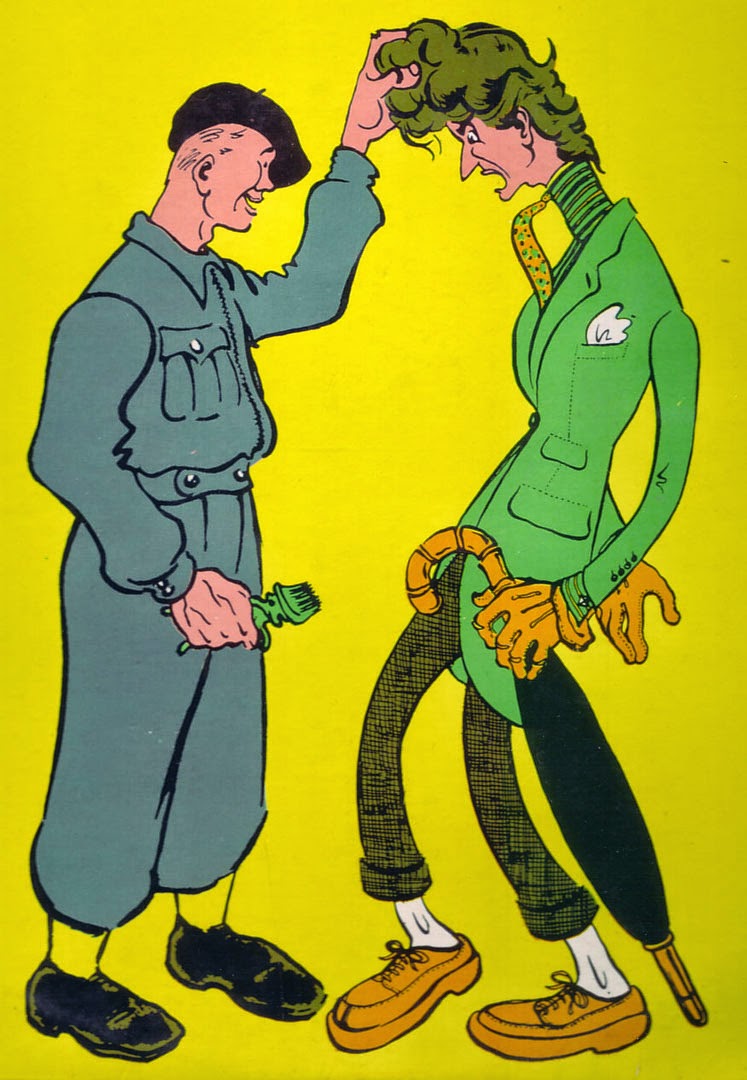
The French version of swing kids wore plaid, and lots of plaid. The male Zazou wore zoot suits with oversize jackets hanging down to their knees and narrow pants cut short above the ankle to show off brightly colored socks. Their hairstyles were greased giant quiffs with the hair in the back reaching down towards the particularly high collars kept in place by a horizontal pin. They wore narrow ties and platform shoes of a style that wouldn't be too far from seventies glam footwear. During the cold months they preferred long sheepskin-lined jackets. The females wore jackets with extremely wide shoulders and short pleated skirts, also with platform shoes, and they refrained from hats, preferring to show off a single dyes or bleached lock in their hairdos. Oversized sunglasses completed the look, and a fur coat might be added to ward off cold. Both men and women quite often carried curved-handle umbrellas as an accessory supposedly mimicking British prime minister Neville Chamberlain, who was regarded as a style icon. Following a government decree in 1942 to collect the hair from barber shops to make slippers and similar items, the Zazou tended to grow their hair longer in protest. A number of Zazou were vegetarians, and their signature cocktail was fruit juice or beer with grenadine. The novelist and anarchist Boris Vian was also part of the Zazou scene, being the writer of several articles on both American jazz and jazz in France and also composing songs of his own.
Jeunesse, a French Fascist magazine, described the Zazou as follows in 1941: "Here is the specimen of Ultra Swing 1941: hair hanging down to the neck, teased up into an untidy quiff, little moustache a la Clark Gable... shoes with too-thick soles, syncopated walk.”

Following the German invasion of France on May 10, 1940, the French Minister of the Interior ordered the dance halls of France to be closed, but most cabarets and clubs remained open. Recording studios closed as the German victory seemed increasingly certain. Following the signing of the armistice on June 22, France found itself split into a German-occupied zone in the north and the Vichy French puppet state in the south under Marshal Philippe Pétain. It should be noted that jazz was never prohibited by the German forces occupying France, although such was not allowed in Alsace, which had been annexed by the Third Reich. It can even be argued that jazz thrived during the occupation, since music became a breath of fresh air for young people. Jazz provided a glimpse of a free world, and of America as opposed to the harshness of the German occupation and the Vichy regime. 

Most of the French entertainment industry went back to business in August 1940, but austere measures such as rationing and requisitioning were to become increasingly prevalent. Laws against Jews and dissidents were also introduced during the Fall of 1940. Both the German occupiers and the Vichy regime shared a similar attitude towards culture, with ultra-conservative morality being increasingly enforced by laws and edicts. Vichy France created a Ministry of Youth in 1940 to properly educate the French youth in the virtues of moral, productivity, labor, family and patriotism. The Zazou are especially targeted for being perceived as subversive slackers. Between 1940 and 1943, the French press published over a hundred articles against the Zazou phenomenon. As in so many other cases, segments of urban youth would have little of this, and the Zazou continued gathering in clubs, at parties and in cinemas.The first "Festival of Swing" was organized by Charles Delauney on December 19, 1940, and it should be noted that the German occupiers privately didn't mind modern music: Johnny Hess was also quite popular amongst the Germans in France. A second "Festival of Swing" was organized on February 2, 1941, which featured Django Reinhardt and orchestra at the Salle Pleyel.

1941 also saw the establishment of French resistance movements, and laws against Communist and Anarchist activities were introduced on August 14, 1941. During the winter of 1941-42 "retaliation closures" of bars, restaurants, clubs and cinemas became more and more common as the Resistance increased its activities. The French jazz culture was, however, increasingly harassed by Nazis and French Fascists, with the German Propaganda Minister Joseph Goebbels banning the "rhythms of belly-dancing negroes".

The American entry into the war meant that American themes weren't allowed any more, but most American popular culture was promptly francofied. For example, the song Gotta Date in Louisiana became We Come to Lausanne.  However, on May 13, 1942, Le Figaro denounced the Zazou and the vogue of jazz in an editorial, and although there were government-approved forms of jazz to be enjoyed, attacks on the Zazou became increasingly common. The Zazous would apparently react to this by shouting "Swing", giving a little hop, then crying out, "Zazou hey, hey, hey, za Zazou!," followed by three slaps on the hip, two shrugs of the shoulder and a turn of the head. But worse was to come. Arrests and raids against jazz establishments were carried out by the police during the summer of 1942, as the Zazou were seen as work-shy, egotistical and Judeo-Gaullist shirkers. The Zazou become " the number one enemy " of the Jeunesse Populaire Française (JPF), the Fascist French youth organization of the collaborationist Parti Populaire Français. The blue-uniformed JPF would use Scalpez les zazous! as their warcry and attack Zazou with fists, clippers and scissors in bars and on the streets. Many Zazou that were old enough were arrested and sent to labor camps in the French countryside.


Furthermore, the first arrests of some 22,000 Parisian Jews took place between July 16 and July 21. Another 5,000 Jews were arrested in Vichy France on August 15. As a reaction to the pogroms, some Zazou took to wearing a yellow Star of David on their clothing with the words "swing", "zazou" or "goy" written in the star. Some Zazou were promptly sent to the Drancy internment camp accused of being "Friends of Jews", although they were usually released, unless they were political undesireables or homosexuals.
The Zazou increasingly sought refuge in underground clubs, being seen as subversives by the French Fascists and not wanting any real part in the resistance movements. They were, after all, a counter-culture and not an oppositional movement. The Zazou started having dance parties without live music, playing their 78s at bals clandestins in cafés off the Champs-Élysées or in the Latin Quarter. There they would throw English slang at each other, swap American novels and jitterbug throughout the night. Enter the discothèque!

After the liberation in 1944, Eddie Barclay, wartime jazz pianist, legendary lounge lizard and founder of the French record industry followed their example and established the first nightclub to dispense with live music. However, much of the French swing scene disappeared after the war, with many of the stars of the war era seen as collaborators, and with the likes of Yves Montand and Charles Aznavour becoming the new voices of French post-war music.

Sources:


libcom.org/history/1940-1945-the-zazous 
www.bangkokeyes.com/agogo.html
growingupmainstream.wordpress.com/2013/01/25/random-subculture-zazou/
www.francemusique.fr/emission/du-caf-conc-la-rive-gauche/2013-ete/zazou-08-06-2013-00-00

camionjazz.com/blog/archives/46


www.histoire.presse.fr/recherche/zazous-enfants-terribles-vichy-01-04-1993-92656

www.folievintage.fr/annees40/zazou/

claude.torres1.perso.sfr.fr/GhettosCamps/Clandestinite/Occupation/Zazous/Zazou04.html

terresdefemmes.blogs.com/mon_weblog/2007/05/13_mai_1942le_f.html
www.telegraph.co.uk/culture/music/3654400/How-the-Nazis-gave-us-disco.html 


Tuesday, May 5, 2015

Jules Verne Bombed Berlin

In 1940, the French Air Forces, the Armée de l'Air and the Aéronautique Navale, were formidable forces, at least on paper. However, the French Air Forces were lacking in doctrine, command, logistics, control and communications. The aircraft had low serviceability, and in general could not meet the performance of British or German types. There was also a shortage of trained pilots, and although many French pilots fought tenaciously, they could not stop the onslaught of the Luftwaffe.

French strategic bombing had had its supporters during the inter-war years, most notably Pierre Cot (1895-1977), who was Air Minister between June 1936 and January 1938. Cot was close to the Communists and was eventually accused of being a Soviet spy, but he saw the rise of the Third Reich as a real threat. The bomber force was tripled by adding five new bomber escadres, converting seven of the twelve observation and reconnaissance escadres to bomber escadres, and equipping four of the five remaining reconnaissance escadres with aircraft capable of long-range bombing. However, by 1940 most of the French bombers were obsolete, and they were squandered as a result of deficient doctrine and tactics, most notably flying bombing missions without fighter escort.

The only long-range bomber available for the French in 1940 was the Farman F.222, a rather ungainly four-engine aircraft dating back to the mid-1930s and the much more modern Lioré & Olivier 451. The latter was however only available in limited numbers. The Aéronautique Navale was also in possession of three Farman 223.4, former postal aircraft that had been requisitioned by the Navy and given the names Camille Flammarion, Le Verrier, and Jules Verne. These were fairly big aircraft, slightly larger than a Lancaster or a Boeing B-17. The Jules Verne, formerly F-ARIN, was assigned to  Lieutenant Commander (Capitaine de Corvette) Henri "the Pasha" Daillière (1901-1942) in April 1940 and crewed by experienced naval aviators: flight engineer Corneillet, navigator Comet (who had crossed the Atlantic before the war), pilot Yonnet, radioman Scour and bombardier Deschamps.

Henri "the Pasha" Daillière
(http://ammacdufumelois.free.fr/memo-marins_bombardent_berlin.htm)

Daillière oversaw a series of modifications to the aircraft at the Toussus-le-Noble airfield, which included the installment of a 7.5 mm Darne machine gun in the right rear access door, eight Alkan bomb shackles under the aircraft, a bomb sight, extra fuel tanks as well as an autopilot. Tricolores were also added.


Lieutenant Commander Daillière very much wanted to use the Jules Verne for strategic bombing, and on May 13 he started off his remarkable career by bombing the marshalling yard at Aachen. However, the aluminum aircraft was found to reflect the searchlights, so the Jules Verne was painted flat black. Over the next couple of days Daillière and his crew successfully attacked several bridges and levees in the Netherlands in vain attempts to stem the German  advance. The aircraft also attacked a German convoy on its way to Dunkirk on May 26, causing significant damage to the German units. It also escorted the cruiser Emilé Bertin with a significant portion of the French gold reserves to Martinique before returning to the campaign in France.

 The Jules Verne (http://ammacdufumelois.free.fr/memo-marins_bombardent_berlin.htm)

On Monday, June 3, a German force of some 300 bombers attacked Paris causing several hundred casualties. The French decided to retaliate, and although they didn't have a comparable number of bombers, a psychological blow to the enemy was deemed necessary. Daillière was given the mission to be the first aviator to attack Berlin with ordnance. He planned to take advantage of the Farman's considerable range and fly around the Western Front to attack Berlin. The Jules Verne took off from the Merignac airfield near Bordeaux on June 7, 1940. The crew proceeded over Normandy, the English Channel, where they were promptly targeted by the anti-aircraft defenses of friendly ships, the North Sea, and over Denmark, where they encountered more Flak over the island of Sylt. The aircraft was not hit, and it flew in over the Baltic Sea before turning south and heading straight for Berlin at high altitude.


On board the Jules Verne, the crew became increasingly tense. The pilot, Yonnet, wrote that "like former corsairs, we are facing the enemy alone...like Robert Surcouf, we must strike first, very hard if possible, to have a chance to escape before the enemy could regain his mind". The Jules Verne reached Berlin just around midnight. Daillière described the approach to Berlin: "I got ready to release the bombs and realized that someone had failed to install our bombsight, so I pressed my nose to the glass of the cockpit." The Berlin area was covered by clouds, and therefore difficult to find, but all of a sudden Daillière spotted the lights of the Tempelhof airfield, and he ordered an approach before accelerating away at low altitude from the airfield.

Daillière flew on over Berlin, still at low altitude and unsynching the engines to vary the engine noise for some time in an attempt to create the impression of a proper formation of bomber aircraft. Eventually eight 75 kg bombs were dropped in two runs over what he assumed was a factory complex in the northern parts of the city as Flak started firing and search lights were turned on. A further 80 incendiaries were dropped by hand by Deschamps and Corneillet  and two or three clips of machine gun ammunition were spent in an attempt to hit the search lights. Flight engineer Corneillet finished the raid by throwing out his shoes at the capitol of the Third Reich.

The return led was less eventful, and they reached Chartres after eleven hours and 40 minutes in the air. The Jules Verne narrowly avoided being hit by a German air raid on Chartres just after taking off to head on to Orly, and after refuelling, back to the base at Merignac, where they landed after 13 hours and 40 minutes and around 3,000 miles in all. As the crew sat down for a well-deserved meal, the pilot, Yonnet, noticed Corneillet's bare feet. The flight engineer simply commented: "You know, they did not win anything. These shoes were almost worn out".


The raid was much praised in French media, and it was claimed both that the mission was accomplished by a formation of bombers and that there were no losses, which of course happened to be true. The French crew was accused by the Germans of being "pirates" and condemned to death lest they flew over Germany again. Daillière claimed that they were "privateers" and not pirates, and they raided an aircraft factory in Rostock three days later.

The Jules Verne continued its career against Italy once Mussolini declared war on France on June 10. The aircraft attacked the Marghera industrial center near Venice and it dropped thousands of propaganda leaflets over Rome. The Jules Verne completed 17 missions against German and Italian targets before the armistice. Following the Fall of France, the Jules Verne was hidden in a hangar, where it was purposefully set on fire in 1942 to avoid having the Germans find the aircraft.


Sources

Lt. Col. (Ret.) Faris T. Kirkland. The French Air Force in 1940. Was it Defeated by the Luftwaffe or by Politics? http://www.airpower.maxwell.af.mil/airchronicles/aureview/1985/sep-oct/kirkland.html

Janusz Piekalkiewicz, The Air War: 1939-1945. Poole: Blandford Press.

http://forum.1cpublishing.eu/showthread.php?t=29232

http://forum.axishistory.com/viewtopic.php?t=52211

http://maquetas.mforos.com/353330/9976648-farman-nc-223-4-jules-verne-1-72-azur-concurso-fuengirola-2011-plata-torrent-2011/

http://forum.worldofwarplanes.com/index.php?/topic/7124-aeronavale-farman-2234/

https://secondworldwaroperationsresearchgroup.wordpress.com/2013/08/11/book-review-unflinching-zeal-the-air-battles-over-france-and-britain-may-october-1940/

http://ecole.nav.traditions.free.fr/officiers_dailliere_henri.htm

http://www.hydroretro.net/etudegh/derniersavionsfarman.pdf

http://www.liveleak.com/view?i=4bc_1346620851&comments=1 (This link has a nice short film about the bombing).

Wednesday, March 18, 2015

Brooklyn Against the U-boats.


A bit more than 71 years ago, on August 7, 1943, a Lockheed PV-1 Ventura aircraft took off from Floyd Bennett Field in Brooklyn at 4.30 in the morning to investigate a report of a u-boat sighting some 300 miles off the Virginia coast around Norfolk, Virginia. Visibility was excellent and the sea was calm with light swells. The Ventura and its crew belonged to the Navy’s Bombing Squadron VB-128, and the squadron’s tasks included anti-submarine patrolling along the Eastern Seaboard.

Following the United States’ entry into the Second World War, German u-boats began attacking shipping along the Eastern Seaboard. The United States was ill-prepared to defend its sea lanes against the Kriegsmarine, which conducted several operations against targets in American waters from 1942 and onwards, including seven attacks against targets anchored in the New York harbor. The u-boat men called this the “Second happy time” (the first such time was had in the Atlantic in 1940-41) or the “American shooting season.” The results were convincing: between January and August 1942, German u-boats sank 609 ships totaling 3.1 million tons for the loss of only twenty-two u-boats. Thousands of lives were lost, mainly merchant mariners, and the United States had to find a way to defend the vital sea lines against the u-boat menace as burning ships dotted the East Coast sea lanes. However, the U.S. response was slow, and it took several months before even convoying was introduced, while cities refused blacking out their lights due to business reasons. The U.S. Forces available to defend the sea lanes were also initially inadequate in terms of training, organization, tactics, quantity and technology.

As the war progressed, the U.S. defenses became more apt at countering the u-boat scourge, and the defenses were also bolstered by British air and sea units. The German operations were scaled down in July as the u-boats sought easier targets further south. Nevertheless, u-boats were to engage targets along the East Coast up to the end of the war. New York City had also expanded the defenses of its waterways, and Naval Air Station (NAS) New York Floyd Bennett Field was a very important part of these defenses, being the base for several operational units. It was also en embarkation point for newly manufactured naval aircraft. The build-up of Navy and Coast Guard forces based at Floyd Bennett Field started even before the U.S. entered the war, and it was officially dedicated as a Naval Air Station on June 2, 1941. Aircraft from NAS NY saw action for the first time on May 1, 1942, when an aircraft sighted a periscope and attacked the target off Fire Island.

As 1942 turned into 1943, Floyd Bennet Field was the base for Squadron VS-34 with twenty-one floatplanes and Squadron VB-128 with twelve Lockheed PV-1 Venturas as well as eleven Coast Guard aircraft. The United States Army Air Force also operated patrol aircraft, albeit from Mitchel Field in Hempstead on Long Island.

The Captain Marvel unit badge of VB-128. It was re-designated as VPB-128 on October 1, 1944

The Lockheed Venturas of VB-128 were bomber and patrol aircraft developed from the civilian Lockheed Lodestar. It was a two-engined aircraft that entered service in December 1942, and it was a fast and rugged aircraft, although somewhat demanding for the pilot to fly. It had a crew of six, a cruise speed of 230 mph, a range of 1,660 miles and it was armed with six machine guns as well as bombs, torpedoes or depth charges.


The Lockheed PV-1 Ventura.

Squadron VB-128 was established on February 15, 1943, and it had been flying various anti-submarine missions throughout the year as part of Fleet Air Wing 9, although without actually sinking an enemy vessel. This particular Ventura (Aircraft P-9, BuNo 29909) was piloted by Lieutenant (jg) Frederick “Ted” Cushing Cross, who was born on July 8, 1917, in Lunenburg, Massachusetts. Cross had enlisted in the United States Naval Reserve on March 22, 1941. Following aviation training, Cross was posted to a bombing squadron at DeLand, Florida, before ending up at Floyd Bennett Field with VB-128.

As Cross and his crew of two flew south, they used the air-to-sea radar on board the Ventura to look for the possible enemy u-boat, and after some time in the air an echo was noticed on the radar screen. They had found their target, in this case the u-boat U-566.

U-566 was a Type VIIC u-boat, the most common type in service with the German Navy. The U-566 had been commissioned on April 17, 1941, and she had conducted five war patrols before being taken over by her current commanding officer, Kapitänleutnant Hans Hornkohl. On August 7, 1943, Hornkohl was leading the tenth war patrol of the U-566, and he may have had reason to feel somewhat satisfied: his crew had just sunk the gunboat USS Plymouth off Virginia only two days before, on the evening of August 5. Of the crew of 155 officers and men, 70 were killed by the single torpedo that sent the gunboat to the bottom of the Atlantic Ocean.

Kapitänleutnant Hans Hornkohl

On August 7, Hornkohl was still sailing in the same general area, in this case off the Delmarva Peninsula, when Cross dove down to attack the u-boat. Hornkohl may have been surprised, or he may have simply decided to slug it out with the attacker, but instead of diving to escape the attacker, he ordered the crews of his 20mm anti-aircraft guns to engage. The results were quite satisfactory, and the Ventura dove into a steady stream of cannon fire. One shell hit and shattered the right engine of the Ventura, causing a fire. Cross himself sustained mortal injuries, probably as a result of being hit by splinters from exploding shells, while his co-pilot and radio operator also were wounded. Yet, Cross continued his attack, even he was in excruciating pain. He dropped four depth charges across the bow of the U-566, although the charges failed to explode. They were possibly not armed properly, or perhaps dropped from too low an altitude. While Cross struggled to keep the damaged Ventura in the air, he soon realized that he had to ditch the aircraft, and he made a Realizing that he couldn’t keep the Ventura in the air, Cross made a perfect emergency landing in the ocean “within 15 miles of 37-35N; 71-20W.” The three wounded aviators managed to leave the Ventura, but Cross succumbed to his wounds and slipped out of his life preserver. The co-pilot and radio operator were rescued by a PBM aircraft some five hours after ditching. Frederick C. Cross was posthumously awarded the Navy Cross.

The crew of U-566 must have been elated to fight off an enemy aircraft (misidentified as a B-25 Mitchell, by the way), but they would have yet another encounter with VB-128 that day, when Lieutenant (jg) Joseph H. “Blackie” George, the son of a Georgia Senator, encountered the u-boat. George was born on November 1916, in Vienna, Georgia, and he became an aviation cadet in the US Navy Reserve as early as October 11, 1938 after having spent some time in both the Georgia National Guard and in other positions within the US Navy Reserve. He served with VP-83 when he was transferred to VB-128 on February 18, 1943. On August 7, 1943, George took off on an antisubmarine patrol flight. After “several minutes”, the aircraft was ordered to 37-35N; 71-20W to “investigate the area and stand by a plane which had landed to pick up survivors of another plane which had been shot down by an enemy submarine.” The last report from George simply acknowledged receiving this message. It may seem odd that there are no further reports from George, but if this was due to atmospheric circumstances, procedures or just negligence is impossible to know.

What happened was that at 6.15 pm, George’s crew spotted the U-566. He dove down to attack, and once again the u-boat crew responded with anti-aircraft fire, hitting the Ventura repeatedly as the aircraft dropped a stick of four depth charges. One actually hit the U-566, but it bounced off the u-boat before exploding. By then the Ventura was burning, and it crashed into the ocean some 1,200 meters from the u-boat. There were no survivors.

The U-566 did speed towards the crash site, but a Ventura from VB-126 and a Mariner from VB-211 appeared, forcing the u-boat to dive away from the scene after an exchange of gunfire for depth charges. Back at Floyd Bennett Field and VB-128, the evening must have been quite somber.


Sources

Michael Gannon. Operation Drumbeat: the dramatic true story of Germany's first U-boat attacks along the American coast in World War II

John C. Stanaway. Vega Ventura. The Operational History of Lockheed’s Lucky Star

The Veteran’s Memorial Hospital’s report on Marcus George (Report 80-6)


uboat.net

vpnavy.com

Friday, March 6, 2015

The Kaiser's Rockets


In April 1916 the Le Prieur rocket  – named after French Lieutenant (N) Yves Paul Gaston Le Prieur - was introduced against observation balloons in the skies above Verdun. The rocket was fired from aircraft such as the Nieuport fighters, SPAD VIIs and Sopwith Pups. The rockets were mounted at an upwards angle on the struts of the biplanes, and they were fired sequentially when the aircraft was diving towards the target. Each rocket contained 200 grammes of black powder, and the rockets were fired electrically at ranges between 100 and 150 meters. The accuracy was dismal, but the weapon was used until incendiary machine gun ammunition became available.  


 Le Prieur rockets mounted on a Nieuport at Cachy in 1916 (http://www.ctie.monash.edu.au/hargrave/le_prieur.html)

The Le Prieur rockets were, of course, noted by the Germans, and future spaceflight pioneer Rudolf Nebel (March 21, 1894 – September 18, 1978) conducted experiments with a German version of an air-to-air rocket. Nebel, who by the way has no connection with the Nebelwerfer of World War Two fame, was born in Weißenburg, Bavaria, but he joined the royal Prussian Jagdstaffel (Jasta) 5 in 1916. Nebel claimed to have come up with an idea for air-to-air rockets while being hospitalized after being wounded in an air battle. Once he recovered, he "cadged several lengths of stovepipe and a supply of large signal rockets such as used by the infantry" from a pioneer depot. It should be noted that although Jasta 5 was formed on January 21, 1916, it wasn’t mobilized until August 21, when it deployed to Bechamp near Verdun. It should also be noted that neither Nebel’s hospitalization, nor his claims of aircraft shot down can be verified by other sources, and it seems as if Nebel may have been prone to embellishment. Many years later he was evaluated by the SS of the Third Reich, and that organization deemed Nebel to be “untrustworthy,”

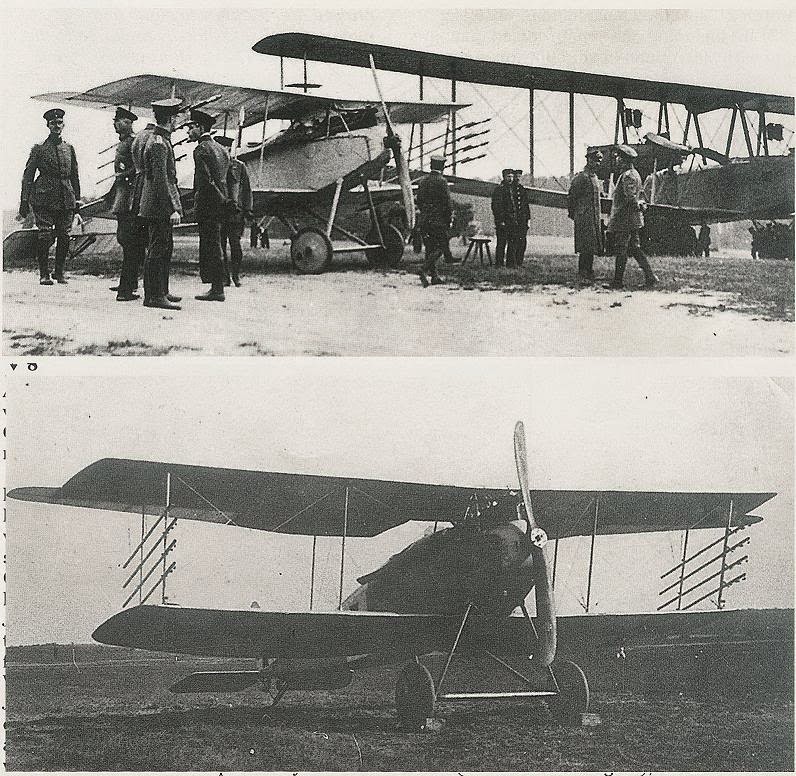
At some point during the late summer or early fall of 1916, possibly before the mobilization of Jasta 5, Nebel mounted four improvised rocket tubes – two on each side - on the wing struts of a Halberstadt D.II, a single-engine fighter plane. The signal rockets were inserted into the tubes, and according to Nebel himself, the device was field-tested when he took off on a defensive patrol as twenty-five British aircraft attacked the airfield. Nebel attacked the enemy aircraft head-on and claimed to have fired his contraption at a distance of 100 meters from the enemy formation. This supposedly made one British pilot so scared that he made an emergency landing behind the German lines, while Nebel landed just 20 meters behind the British aircraft to capture the pilot. Nebel also claimed that he conducted the same experiment a week later, this time succeeding in blowing off the propeller of an enemy aircraft, thus causing it to crash. According to Nebel himself, he also conducted rocket experiments with an Albatros D.III, but a rocket exploded prematurely, injuring Nebel and leading to further trials being prohibited. If this experiment really took place, it may have been in 1917, considering that the Albatros D.III wasn’t introduced until December 1916.

 
On October 16, 1916, a German Raketentrupp equipped with a Halberstadt D.II armed with with four Le Prieur-type rockets mounted on each of the outer struts went to the 1. Armee for more formal experiments in engaging observation balloons with rockets. However, problems with the ignition system led to the end of the rocket experiments after two weeks, and the Raketentrupp returned to Berlin.
 
  
These photographs of the rocket-armed Halberstadt were taken at Doberitz, either during display or evaluation. (wingsofwar.com).
 

Rudolf Nebel continued to fly for Jasta 5 for quite some time. He scored an unconfirmed victory over a D.H. 2 on March 11, 1917, and another unconfirmed victory over a F.E. 2b on April 26. Meanwhile, Heinrich Gontermann, also of Jasta 5 and a future ace, did some experiments with Leuchtkugelpfeile (“flare arrows”) ins the spring of 1917. These “arrows” may have been stick-stabilized signal flares, and on April 8 Gontermann claimed that he had “…an unsuccessfull attack on a balloon around 6 p.m.” The balloon did catch fire, and accurate anti-aircraft fire forced Gontermann to break off the attack. At the end of his report Gontermann said that he “will try to attack the balloons the next time with self-made Leuchtkugelpfeile”. In a letter to his parents dated 15 April 15, 1917, he wrote that a balloon attack with these rockets had been successful on April 13 when he flamed a French balloon at 7.40 p.m near St.Quentin.

In early 1918, Leutnant Rudolf Nebel was transferred to Kest (Kampfeinsitzerstaffel) 1b. He was apparently not regarded as a particularly efficient combat pilot, but other talents and experience led to him commanding Kest 1b until May 1, 1918, when he took command of Kest 1a (later renamed Jasta 90) for the rest of the war, flying Fokker D.VIIs in mainly home defense missions. On September 7 his unitg engaged twelve D.H. 9s over Bühl, and he landed with 29 bullet holes in his Fokker, although three D.H. 9s were brought down.

Following the war, Rudolf Nebel earned an engineering degree and continued to pursue his passion for rocketry. He was very active in the VfR (Verein für Raumschiffahrt, the Association for Space Flight). He was also associated with right-wing veterans’ organizations such as Stahlhelm. He did not, however, get along with German Army, and when offered a position as rocket researcher for the army, he declined. The job was instead given to a young Werner von Braun. He continued his rocket advocacy after the end of World War Two and up to his death. 


(Left) A 1932 publication on rocketry written by Nebel. (Right) Flyer for the VfR (astronautix.com)


 (jean-maridor.org)